
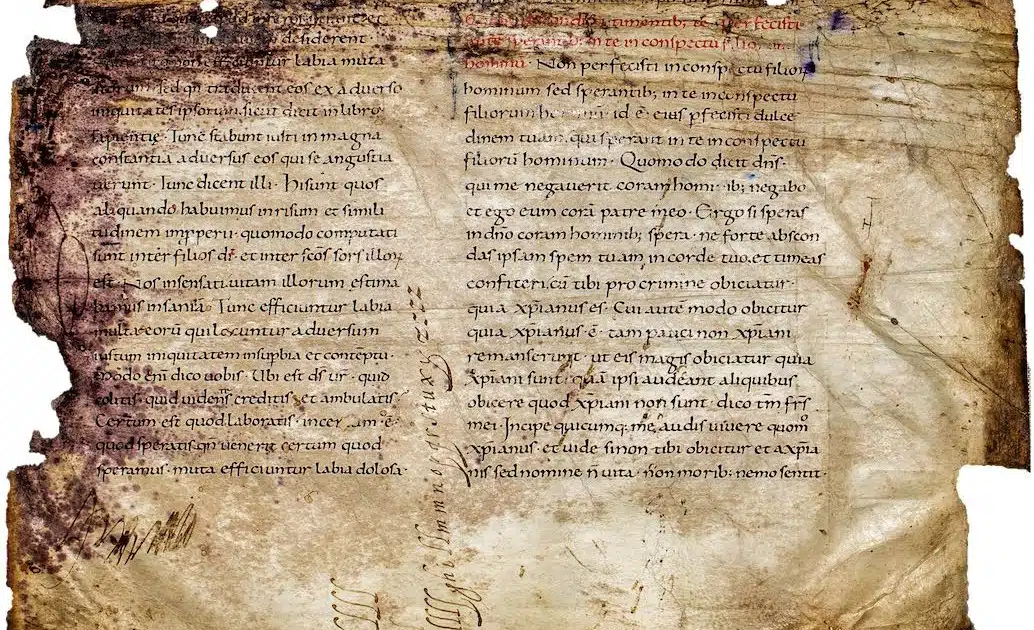
The Carolingian Parchment – © Francesco Lascialfari, con il supporto di Giorgio Cuneo
The Carolingian Parchment is one of the rarest and most fascinating historical, cultural, and philological artifacts preserved in Rio nell’Elba. Dating back to the 10th century (fully attributable to the Carolingian period between the 9th and 10th centuries), this manuscript fragment represents one of the absolute oldest written and preserved records on the entire Island of Elba, documenting the circulation of religious texts and the scribal culture of the late Carolingian era.
The Extraordinary Discovery
The discovery dates back to 1991, when German historian Peter Zahn, engaged in research on Tuscan mining history, noticed the unusual binding of the Statuta Rivi codex (the oldest legal code of Rio nell’Elba). At the beginning of the 18th century, two Carolingian-era folios from a text now lost were reused precisely to reinforce the cover of the Statuta. The parchment featured fine, elegant Carolingian minuscule script with details in black and red ink.
The Augustinian Text and Philological Value
The folios contain Augustine Aurelius’s (Bishop of Hippo in the 4th century) commentary on the Psalms: specifically, the commentary on Psalm 30 (from verse 19 to 25) and the beginning of Psalm 31, taken from his famous Enarrationes in Psalmos. Beyond the manuscript’s historical value, the study of the fragment revealed an extraordinary philological discovery. In an Augustinian passage where later transcriptions read “creditis et laboratis”, the Rio fragment confirmed the oldest and most authentic reading: “creditis et ambulatis” (“you believe and you walk”), a phrase of profound theological weight defining faith as a dynamic journey.
A Bridge Between European Culture and Local History
The arrival of this manuscript in Rio nell’Elba bears witness to the intense cultural exchanges between the Holy Roman Empire and the Italian peninsula, where students, clerics, and monks from across the Alps frequently traveled. This phenomenon is comparable to what occurred in the great Italian Benedictine monasteries—such as Santa Scolastica and Santo Speco in Subiaco—true international hubs where communities of German, French, Flemish, and Italian monks and printers laid the foundations for the spread of the book. Thanks to this curious 18th-century reuse, the parchment not only restores a page of European religious history, but also inextricably weaves itself into the legislative and community history of Rio, becoming a fascinating bridge between two fundamental eras of the island.
Useful Information
Location: Rio nell’Elba
Period: 10th century / Carolingian era (9th–10th century)
The Carolingian Parchment is one of the rarest and most fascinating historical, cultural and philological artefacts held in Rio nell’Elba.
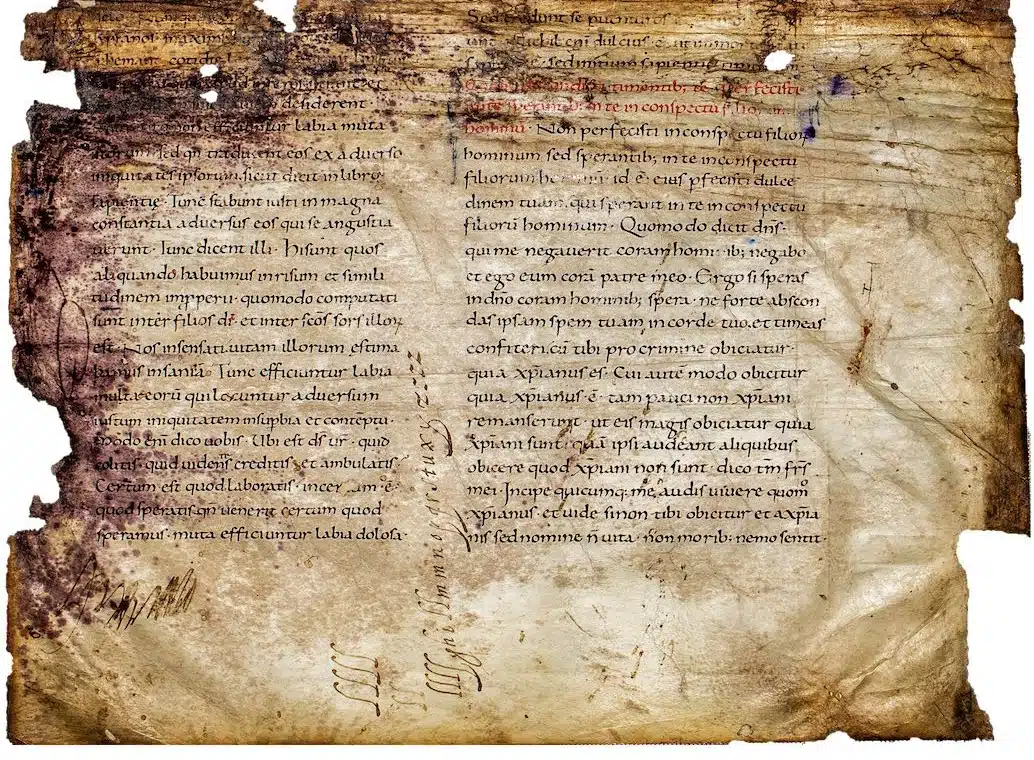
Click to watch the video on Facebook; you’ll need to be logged in to view it, and it’s easier to watch on a mobile.

Dove si trova: Rio nell’Elba